
I have failed miserably at several attempts to change habits. These include maintaining a regular exercise routine, fasting, and quitting coffee. Lately, however, I’ve had the mental space and energy (and the feeling of midlife creeping up on me) required to actually change some deeply ingrained habits. These include quitting alcohol, keeping my phone out of the bedroom and reintroducing daily meditation. Having previously coached others to change behaviours, using coaching methods such as the GROW model and Motivational Interviewing, I have used the same methods on myself. In addition to using coaching tools, I approached habit change with a curious, pseudo-scientific mindset.

These are some techniques that have worked for me, along with links to resources that have proven useful. There are endless other ways to quit and build new habits. Take from it whatever is useful to you. How much structure and micro-management each of us wants to apply to your life varies widely. So please be mindful of how you want to approach changes in your own life: with fun and ease, or by rigorously applying all the tools available.
Clear values and visions
It might be obvious to you why you want to change a certain habit. But change requires a lot of effort over time. To avoid being tempted to take the easy path, reminding youself on why you are making the change can be the one motivation that keeps you on track. Changing habits can look like you’re becoming a different person (and indeed, you are) and can feel confusing and threatening to people around you. Being clear on what is most important to me in my life right now and having a clear sense of who I want to be has given me the strength to no longer live up to my old identity. For me, imagining myself hiking and traveling well into my senior years is a great motivation to keep my healthy habits. My future dream scenarios are tied to my values around adventure, nature and health.
I have written about values work here.
My husband and I also used Pixar’s Story Spine to help us create compelling stories about our desired future state and motivations. This can be a fun exercise to do alone or with someone. Revisiting your story later is also a good way to see whether you are closer to your dream or if your dream has changed.
Knowledge is power
Seeking information and understanding how our brains work can help us develop strategies and overcome obstacles. Our brains are wired for survival and want to keep us safe by tending to the familiar. Dopamine seeking drives our behavior, and makes it especially hard to stop unhealthy habits that give us a fast reward, like sugar, nicotine and alcohol. Having the vocabulary and some mental models, like how the pain-pleasure balance in the brain works, has been helpful to me.
- Choice Point: a useful model to look at choices as behaviour that either takes you towards or away from your desired habit.
- Dopamine Nation: especially interesting if you want to quit habits.
- Atomic Habits: not the newest science, but still very useful and practical tips on behaviour change.
- The Habit Loop
Mapping habit loops
You cannot change what you cannot see. Before you jump ahead and try to change anything, it can be useful to start where you are and become aware of your current habits. This is where the mental model of habit loops enters. The number of steps and vocabulary used to describe habit loops vary. James Clear uses cue, crawing, response and reward. I chose to use Dr. Jud Brewer’s steps: trigger, behaviour, reward. Over a couple of weeks of tracking my habit loops, I caught my own thoughts defending why being lazy was a good idea. I became more familiar with this conservative, concerned, and change-avoidant voice in my head, which goes to great lengths to preserve homeostasis. This allowed me to deploy strategies to reassure the worried voice that the change was okay and to let the safe, ambitious, and courageous part of me take over.
Experimenting
In my work as an agile coach, I often have described experiments using this template from John Cutler. The experiment is described in terms of duration, purpose, desired outcome and possible obstacles. I find it useful to think about (or, even better, write down) my answers to these questions in relation to new habits I want to try.
Duration
For the duration of the experiment, I find it useful to use the rhythm of the calendar. Dr. Anna Lembke recommends 30 days to reset the brain’s pain-pleasure balance. So, especially if you’re quitting a habit, like coffee or alcohol, a month will let you get over the abstinence and reset your dopamine baseline. So I decided to use each month as a temporal landmark, adding a reflection and adjustment at the change of each month.
Desired outcome
To describe the desired outcome in each experiment, I made some assumptions about what the habit would lead to. When I can measure the result with my smart ring, I describe an observable outcome. Others were more objective experiences. I actually don’t think everything should be measured – something is better felt in the body (but that’s another discussion).
These are some examples of desired outcomes related to some of the habits I have tried:
➡️= causes
✅= supported
❌= rejected
- Cold swimming ➡️ More retorative time (❌)
- Reading books before bed ➡️ Better sleep (✅)
- Daily formal meditation ➡️ Deeper concentration (✅)
- Daylight before screenlight ➡️ Better sleep (✅)
- Swapping coffee for matcha ➡️ More energy in the afternoon (✅)
- Swapping smartphone for dumbphone ➡️ A simpler and easier life (❌)
As you can see, some habits did not lead to the desired outcome and were therefore aborted.
Tracking progress
As mentioned, I use a smart ring for measuring my health. After almost three years of wearing one, I am also very cautious about using wearables and biometrics. I have both had great scores and felt totally drained, and the opposite. In some ways, using a smart ring has made me more aware of certain effects on my body. For example, I don’t think I would have quit alcohol if it weren’t for the alarming negative effects it had on my health scores. However, I must admit I have found myself deep in analyses of HRV, heart rate and VO2 max, involving both AI and extensive research. Obsessing over metrics can be interesting and fun for a while, but it can also lead to more stress and, ironically, worse health.
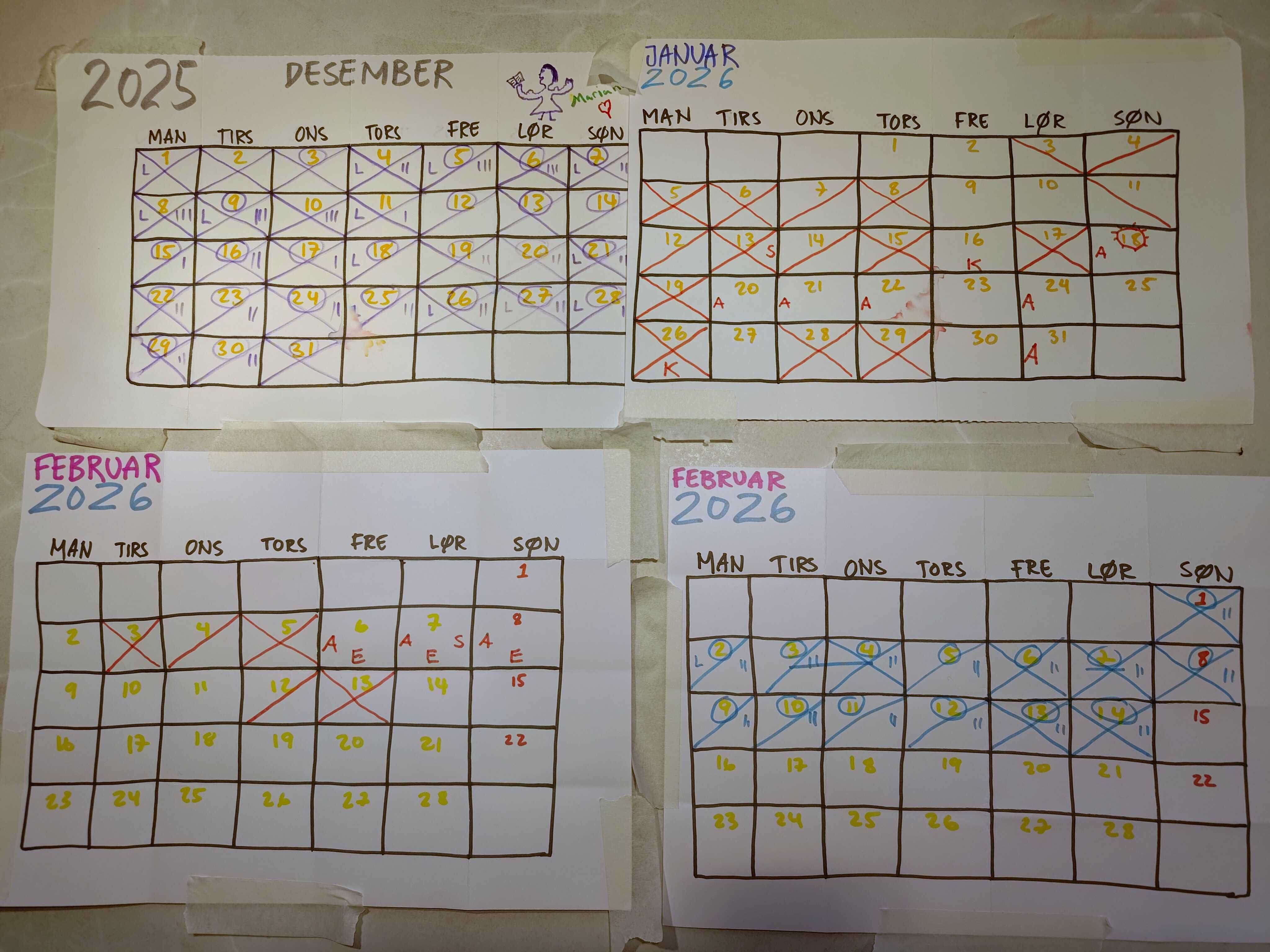
A better way to track habits, I think, is an analogue, visual, available, tangible habit tracker combined with daily and monthly reflection (not automated or digital, as James Clear promotes). With good old pen and paper, I make calendars for my husband and me every month, where we are deliberate about what habits we want to track. Tracking your habits requires you to be clear about which concrete behaviours count and which do not. We often have to remind ourselves about the purpose of the habit.The discussions and reflections that follow can lead to greater clarity.
Mindfulness
Being mindful is a key skill in changing habits. Having a space between your thoughts and your behavior can make all the difference when stopping yourself from engaging in unwanted behavior. This is how you break the habit loop. When I’m mindful, I can catch my thoughts as they try to argue that skipping the gym is a good idea. Mindfulness allows me to catch my thoughts with their pants down. I cannot help but laugh at them (in a warm and friendly way), then they become embarrassed and retreat. I’m then free to make the decision that takes me towards my desired life.
As a result of being more mindful in my day-to-day life, I find that many other things shift as well. These are results that are hard to measure, such as a lighter mood, greater payfulness, more energy, deeper relationships and greater care for myself. This is a great reminder that even the smallest change can shift the whole trajectory of your life. You don’t have to wait until you have capacity to change many big habits all at once. A small step in a new direction can make all the difference in the long run.
Mindfulness is a tool for changing habits, and meditation is a habit that trains your focused awareness. Read more about my thoughts on mindfulness here.
Celebrate
In order for your brain to change its preferred neural pathways, you sometimes have to trick yourself into liking the new habit more than the old. Take a moment to be proud of yourself and reward yourself for the desired actions you take, or be curious about how your new behavior feels. Feeling follows behaviour, as this post brilliantly describes. Gamification can also work, like giving yourself points or stickers on a calendar.
How you reward yourself can either enhance or reduce your intrinsic motivation. Stacking dopamine-triggering behaviors is usually not recommended anymore (contrary to what we believed earlier, based on books like Atomic Habits). According to Andrew Huberman, if you enjoy going to the gym, adding music and coffee to that experience will reduce the joy you get from exercising in and of itself.
Other tips
- Start small. Ambitions can be high, but the first step is more likely to succeed if it is small and obtainable.
- Design your environment for success. Willpower is unreliable and weak. Don’t have candy in your house if you don’t intend to eat it.
- Invest in your new lifestyle. If you want to use your bike instead of public transportation, take care of it and maintain it.
- Be vocal about your new habits. You will feel more accountable once you voice your intentions to others.
- Visualize your habits and keep track of your progress.
- Connect your habits to other fixed routines. Practicing 5 minutes of mindfulness meditation can piggyback on your already established habit of brushing your teeth.
- Consistency over speed. Slow and steady wins the race.
- Be aware of the obstacles you might face and have strategies to overcome them.
- Be kind to yourself. Getting out of our habit loops and building new ones is hard work. See failure as an opportunity to learn, and simply start again.
What is your own experience with changing habits? What tools, tips and methods have (not) worked for you? Don’t be shy to leave a comment!

 context is queen