Changing habits

I have failed miserably at several attempts to change habits. These include maintaining a regular exercise routine, fasting, and quitting coffee. Lately, however, I’ve had the mental space and energy (and the feeling of midlife creeping up on me) required to actually change some deeply ingrained habits. These include quitting alcohol, keeping my phone out of the bedroom and reintroducing daily meditation. Having previously coached others to change behaviours, using coaching methods such as the GROW model and Motivational Interviewing, I have used the same methods on myself. In addition to using coaching tools, I approached habit change with a curious, pseudo-scientific mindset.

Daily cold baths were an overambitious habit that lasted two weeks for me (my husband, on the other hand, has managed to continue cold showers – I think it is because he experienced more benefits, like a slow and steady dopamine release).

These are some techniques that have worked for me, along with links to resources that have proven useful. There are endless other ways to quit and build new habits. Take from it whatever is useful to you. How much structure and micro-management each of us wants to apply to your life varies widely. So please be mindful of how you want to approach changes in your own life: with fun and ease, or by rigorously applying all the tools available.

Clear values and visions

It might be obvious to you why you want to change a certain habit. But change requires a lot of effort over time. To avoid being tempted to take the easy path, reminding youself on why you are making the change can be the one motivation that keeps you on track. Changing habits can look like you’re becoming a different person (and indeed, you are) and can feel confusing and threatening to people around you. Being clear on what is most important to me in my life right now and having a clear sense of who I want to be has given me the strength to no longer live up to my old identity. For me, imagining myself hiking and traveling well into my senior years is a great motivation to keep my healthy habits. My future dream scenarios are tied to my values around adventure, nature and health.

I have written about values work here.

My husband and I also used Pixar’s Story Spine to help us create compelling stories about our desired future state and motivations. This can be a fun exercise to do alone or with someone. Revisiting your story later is also a good way to see whether you are closer to your dream or if your dream has changed.

Knowledge is power

Seeking information and understanding how our brains work can help us develop strategies and overcome obstacles. Our brains are wired for survival and want to keep us safe by tending to the familiar. Dopamine seeking drives our behavior, and makes it especially hard to stop unhealthy habits that give us a fast reward, like sugar, nicotine and alcohol. Having the vocabulary and some mental models, like how the pain-pleasure balance in the brain works, has been helpful to me.

  • Choice Point: a useful model to look at choices as behaviour that either takes you towards or away from your desired habit.
  • Dopamine Nation: especially interesting if you want to quit habits.
  • Atomic Habits: not the newest science, but still very useful and practical tips on behaviour change.
  • The Habit Loop

Mapping habit loops

You cannot change what you cannot see. Before you jump ahead and try to change anything, it can be useful to start where you are and become aware of your current habits. This is where the mental model of habit loops enters. The number of steps and vocabulary used to describe habit loops vary. James Clear uses cue, crawing, response and reward. I chose to use Dr. Jud Brewer’s steps: trigger, behaviour, reward. Over a couple of weeks of tracking my habit loops, I caught my own thoughts defending why being lazy was a good idea. I became more familiar with this conservative, concerned, and change-avoidant voice in my head, which goes to great lengths to preserve homeostasis. This allowed me to deploy strategies to reassure the worried voice that the change was okay and to let the safe, ambitious, and courageous part of me take over.

Experimenting

In my work as an agile coach, I often have described experiments using this template from John Cutler. The experiment is described in terms of duration, purpose, desired outcome and possible obstacles. I find it useful to think about (or, even better, write down) my answers to these questions in relation to new habits I want to try.

Duration

For the duration of the experiment, I find it useful to use the rhythm of the calendar. Dr. Anna Lembke recommends 30 days to reset the brain’s pain-pleasure balance. So, especially if you’re quitting a habit, like coffee or alcohol, a month will let you get over the abstinence and reset your dopamine baseline. So I decided to use each month as a temporal landmark, adding a reflection and adjustment at the change of each month.

Desired outcome

To describe the desired outcome in each experiment, I made some assumptions about what the habit would lead to. When I can measure the result with my smart ring, I describe an observable outcome. Others were more objective experiences. I actually don’t think everything should be measured – something is better felt in the body (but that’s another discussion).

These are some examples of desired outcomes related to some of the habits I have tried:

➡️= causes

✅= supported

❌= rejected

  • Cold swimming ➡️ More retorative time (❌)
  • Reading books before bed ➡️ Better sleep (✅)
  • Daily formal meditation ➡️ Deeper concentration (✅)
  • Daylight before screenlight ➡️ Better sleep (✅)
  • Swapping coffee for matcha ➡️ More energy in the afternoon (✅)
  • Swapping smartphone for dumbphone ➡️ A simpler and easier life (❌)

As you can see, some habits did not lead to the desired outcome and were therefore aborted.

Tracking progress

As mentioned, I use a smart ring for measuring my health. After almost three years of wearing one, I am also very cautious about using wearables and biometrics. I have both had great scores and felt totally drained, and the opposite. In some ways, using a smart ring has made me more aware of certain effects on my body. For example, I don’t think I would have quit alcohol if it weren’t for the alarming negative effects it had on my health scores. However, I must admit I have found myself deep in analyses of HRV, heart rate and VO2 max, involving both AI and extensive research. Obsessing over metrics can be interesting and fun for a while, but it can also lead to more stress and, ironically, worse health.

A better way to track habits, I think, is an analogue, visual, available, tangible habit tracker combined with daily and monthly reflection (not automated or digital, as James Clear promotes). With good old pen and paper, I make calendars for my husband and me every month, where we are deliberate about what habits we want to track. Tracking your habits requires you to be clear about which concrete behaviours count and which do not. We often have to remind ourselves about the purpose of the habit.The discussions and reflections that follow can lead to greater clarity.
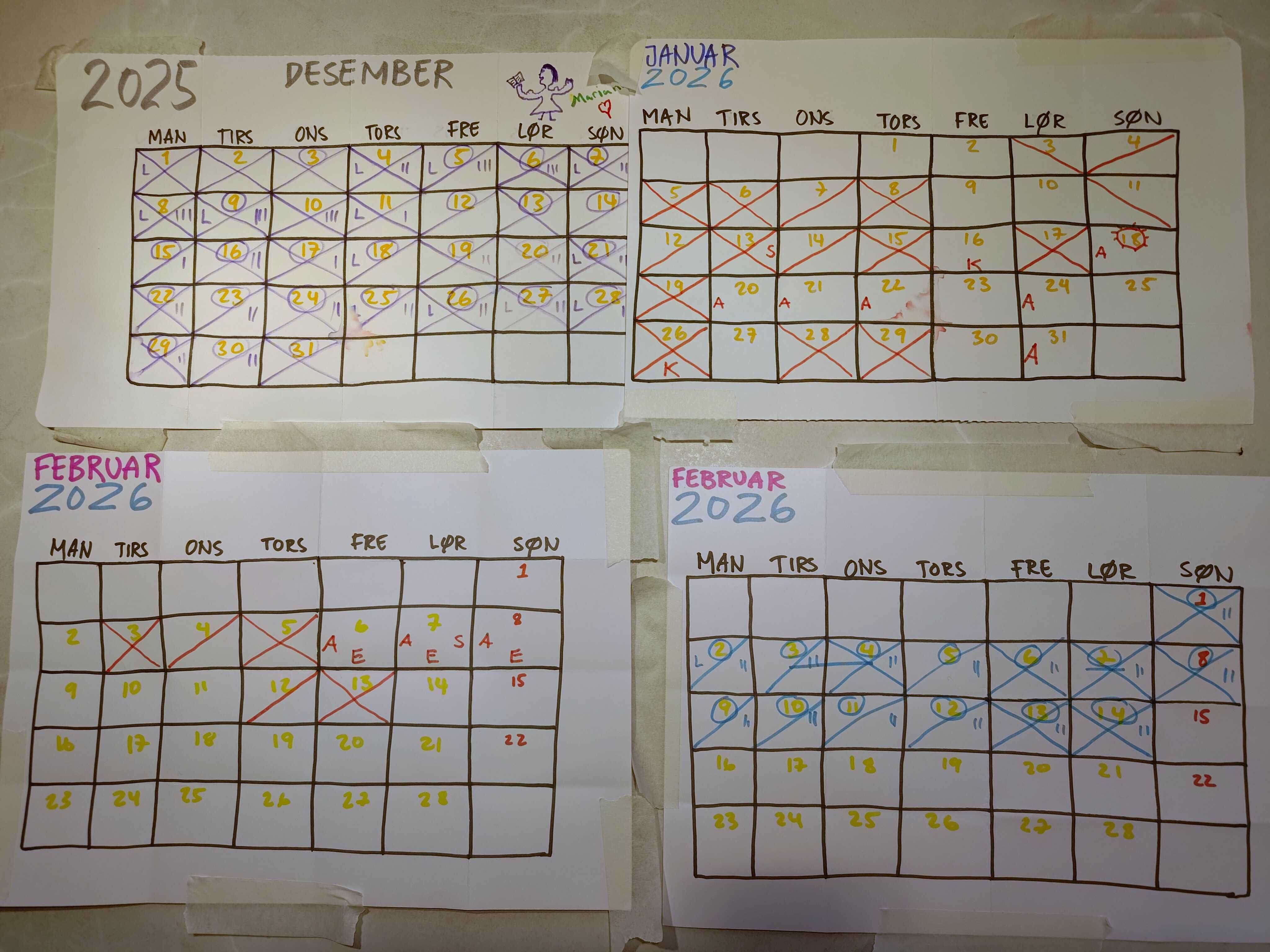
For the last six months, my husband and I have tracked the habits we want to change in monthly calendars. The calendars are visible throughout the apartment. The symbols have different meanings. At the end of each month, we adjust the habits and symbols.

Mindfulness

Being mindful is a key skill in changing habits. Having a space between your thoughts and your behavior can make all the difference when stopping yourself from engaging in unwanted behavior. This is how you break the habit loop. When I’m mindful, I can catch my thoughts as they try to argue that skipping the gym is a good idea. Mindfulness allows me to catch my thoughts with their pants down. I cannot help but laugh at them (in a warm and friendly way), then they become embarrassed and retreat. I’m then free to make the decision that takes me towards my desired life.

As a result of being more mindful in my day-to-day life, I find that many other things shift as well. These are results that are hard to measure, such as a lighter mood, greater payfulness, more energy, deeper relationships and greater care for myself. This is a great reminder that even the smallest change can shift the whole trajectory of your life. You don’t have to wait until you have capacity to change many big habits all at once. A small step in a new direction can make all the difference in the long run.

Mindfulness is a tool for changing habits, and meditation is a habit that trains your focused awareness. Read more about my thoughts on mindfulness here.

Celebrate

In order for your brain to change its preferred neural pathways, you sometimes have to trick yourself into liking the new habit more than the old. Take a moment to be proud of yourself and reward yourself for the desired actions you take, or be curious about how your new behavior feels. Feeling follows behaviour, as this post brilliantly describes. Gamification can also work, like giving yourself points or stickers on a calendar.

How you reward yourself can either enhance or reduce your intrinsic motivation. Stacking dopamine-triggering behaviors is usually not recommended anymore (contrary to what we believed earlier, based on books like Atomic Habits). According to Andrew Huberman, if you enjoy going to the gym, adding music and coffee to that experience will reduce the joy you get from exercising in and of itself.

Other tips

  • Start small. Ambitions can be high, but the first step is more likely to succeed if it is small and obtainable.
  • Design your environment for success. Willpower is unreliable and weak. Don’t have candy in your house if you don’t intend to eat it.
  • Invest in your new lifestyle. If you want to use your bike instead of public transportation, take care of it and maintain it.
  • Be vocal about your new habits. You will feel more accountable once you voice your intentions to others.
  • Visualize your habits and keep track of your progress.
  • Connect your habits to other fixed routines. Practicing 5 minutes of mindfulness meditation can piggyback on your already established habit of brushing your teeth.
  • Consistency over speed. Slow and steady wins the race.
  • Be aware of the obstacles you might face and have strategies to overcome them.
  • Be kind to yourself. Getting out of our habit loops and building new ones is hard work. See failure as an opportunity to learn, and simply start again.

What is your own experience with changing habits? What tools, tips and methods have (not) worked for you? Don’t be shy to leave a comment!

Changing habits

Discover (and Rediscover) Your Values

“I cannot use this microphone”, my colleague gently told me, right before entering the stage where she was going to give a talk. The microphone was supposed to go behind her ears, but she was wearing a hijab. I immediately felt my stomach drop and embarrassment for my own ignorance. How could I not have thought about this? An honest mistake, still, I felt that I had stepped on one of my core values: inclusion.

What are values?

Values can be personal and also be held by different social groups, as you might be familiar with in your organisation, in your team at work or in sports. In social settings, values align us and guide decisions and behaviour, creating a culture that’s (hopefully) adaptive to its context. Values can be held by countries too. In The Values Compass, the author, Dr Mandeep Rai, assigns different values to different countries (I can’t help but feel proud that she assigns the value of diplomacy to my home country, Norway: “being independent, humble, and willing to engage”. What a badge!).

In our personal lives, values are our heart’s deepest desires. They are what we truly care about, and how we want to live and show up in the world. We all have our unique set of values. Some values are shared by most humans, such as connection, while others are more unique. There are no right or wrong values, no values are better than others, and we can all honour and be proud of our own values.

To see some examples of values:

Prioritized

Values can, and maybe should, be prioritised. A couple of years ago, I remember reading about the differences in values between Republicans and Democrats in the US. The article said that we all have the same values: for example, freedom and family are important to most people. It’s the priority of our values that makes them different.

Core values

Your highest prioritised values are often called core values. Some describe core values as constant throughout your life, and something you never want to compromise on. Others believe they are more fluid. What’s your experience? Do you believe that your values were shaped in early childhood years and are a fixed part of your personality? Or have your values changed over time? Personally, I see a shift from deeply caring about compliance and independence to prioritising flexibility, intimacy and connection in my life.

How many values

Brené Brown says you should limit yourself to two values, which are universal across your professional and personal life. Others say you can have different values across different areas of your life, as in the Bull’s-eye exercise. The Values Bridge claim there are only 16 human values, and that we have a hierarchy of core, moderate, and peripheral values. And if you want people to remember your company or team values, many recommend limiting them to the magical number three, though many companies don’t follow this advice.

Yes, I’m also confused. Values work is not an exact science. Labelling, categorising and rationalising about something as abstract as values will inevitably lead to a myriad of different models. Models are not reality. All models are wrong, but some are useful. Follow whatever recommendations resonate with you.

Personally, I find it useful to apply different values to different areas of my life. Sometimes I have one value at the front and centre of everything I do. Other times, it’s a whole sports team of values guiding me. In this brilliant episode on values at The Imperfect Podcast, a sports analogy is used: your values are the players, and you can choose which ones are on the bench and which ones are playing at any given time and place. I would also add that how many values are at play at once is up to you. What kind of sport do you imagine your values are playing? For me, I think of soccer.

Values are not

  • Goals. Unlike values, goals are tangible, achievable outcomes.
  • Principles. Unlike values, principles are actionable, concrete guidelines.
  • Feelings. Unlike values, feelings come and go on their own.
  • Expectations (but your company’s values might be)

Be mindful of when you are using the word “should” in relation to your personal values. That might indicate that the values are unconsciously derived from others’ expectations of you or from what you think society would value.

When working with values, we eventually find ourselves in discussions like “Is this a value or not?” For example, some say that health is not a value. You can ask yourself what good health will allow you to do, and that might point you to the underlying value. Nature is another one that’s debatable, because it’s not a doing word (verb or adverb). I still choose to hold nature as a personal value because it gives me direction in life, even though some might say it isn’t a value.

It’s also common to use values and principles as synonyms. In my work with values, I haven’t seen any major problems with not being strict about these definitions, as long as we are clear on what the words or sentences mean. Have fun with it, and don’t let yourself get too caught up in the semantics (unless rigidity is your core value, then please go ahead and take it very seriously).

Scepticism and fear

Throughout my career as an agile coach, I have worked with values in teams, communities, departments and in 1:1 coaching. My experience is that, understandably, values work can lead to a lot of aversion and frustration. We have all seen the fancy words on shiny posters that are inconsistently acted on. Values can feel important to the people who defined them, but meaningless to those who didn’t participate in creating them. Working with values and putting them into practice, whether it is in your personal life or at work, requires ongoing reflection and action.

Some say that values drive our behaviour. This is not always true. Sometimes, you go in the opposite direction and feel a short-lived sense of relief, only to be followed by guilt and despair. For example, you avoid going to the gym even though that would be more in line with your values. Living by our values can be uncomfortable and sometimes requires courage. Fear can also steer us away from living by our values. For example, you might value knowledge sharing, but your fear of public speaking keeps you from speaking up. Living by our values can be painful and hard. It requires a willingness to meet our pain and fear with compassion.

Benefits of knowing your values

Have you ever achieved a goal and then felt empty afterwards? Or felt that life is without a direction or a purpose? These are signs that you are not living by your values, you might not be aware of them, or your values or what they mean to you might have changed.

Knowing your personal values is key to understanding yourself and guiding you towards a purposeful life. Values are often referred to as our inner compass. When we live from our values, we usually feel a sense of purpose, integrity and motivation. When we don’t live by our values, we can feel lost, confused, disconnected and drained of energy.

If you are not convinced yet, these are some of my favourite reasons why it is useful to know your values:

  • Values give you a sense of direction, purpose and stability in life
  • Values help us get to know ourselves and others better
  • Values uncover where we are not living the life we truly want
  • Values create a sense of agency: No matter the circumstances, you can always choose to act in accordance with your values. Even when you can’t control the outcome, you can still feel good about your actions.
  • Values make decision-making easier, and you become more confident in your decisions
  • Values give you a clearer sense of your identity and help you create an external consistency in who you are. For example, if you deeply value and live by honesty, people in your life will know they can trust you.
  • Values make goals and habits more motivating when they are connected to your values

Values in a relationship

If values can be held by different social groups, why can’t they also be held by couples? Having married a facilitation geek, my husband had little choice but to co-discover our values together. One value that has recently arisen to the surface (not related to midlife crisis at all) is adventure. Being adventurous was important to us before, but it’s even more important now. It’s like we pulled adventure off the bench (remember the sports analogy?). Making this value explicit helps us when planning events or prioritising what to do. If it does not feel like an adventure (and we are still debating what counts as an adventure), we simply no longer do it.

If it’s not an adventure, we’re not going!

Discovering your own values

Do we discover our values, or do we freely choose them? Are they already present in us, or can we decide on whatever values we like? How do we know they are our values, and not the values of our society or our peers? In Acceptance and Commitment Therapy (ACT), values are said to be “freely chosen“, meaning they are free from aversive control. I think this wording is unfortunate when it comes to personal values, and it’s more helpful to think of values as “discovered” or “uncovered”. Organisational values, on the other hand, I think, can be freely chosen (not necessarily discovered), based on what we want to change.

Since personal values are to be uncovered, I recommend working on them from different angles over time, iteratively. Take your time. Values work is an ongoing, never-ending process. If you don’t actively use them, they will start to gather dust again. Write them down and keep them visible if that feels right for you.

Here are some angles you can take when approaching your personal values.

Select from a list or take an online test

If you want to do a quick-and-dirty first iteration, you can simply choose from a list of values. You can use the elimination method, cutting the lists in half until you have about 2-5 values left. However, without reflecting on and feeling your way into it, you might end up with a list of values you think you should have, rather than your heart’s deepest desire. So be mindful about how you choose and reflect on your values.

Also, remember that words mean different things to different people. Make sure to dig one layer further down, to what your chosen value words look like to you. Don’t be shy to come up with your own words that are not on any list. Why not smash two words together and create a truly unique one?

Extrapolate values from strengths

The VIA Character Strengths Survey, from positive psychology, is a test for finding your strengths, and this can also point you to your values. Based on my top five strengths, I identified values such as open-mindedness, inclusion, wisdom, and honesty.

Turning towards your body and feelings for guidance

We all have personal values, whether we are conscious of them or not. Finding your values is more about uncovering them in your body than creating them in your mind. Values are connected to your emotions, so being aware and mindful of how you feel in any given situation makes it easier to uncover them. Emotions are information from your body that asks for your attention. If you’re not as connected to your feelings, you can still go towards what gives you energy and where you find yourself engaged. Chances are that’s also where you find what is truly important to you, i.e. your values.

Reflect on relevant questions

These are some prompts that might help point you towards your values:

  • Imagine it’s your future funeral, retirement or an anniversary, where the people in your life are speaking about you. What do you wish they would say about how you’ve lived your life?
  • Remember a time when you felt truly engaged. It could have been at work or in any other setting. What were you doing? What was it about that experience that was really important to you?
  • Look to your emotions: Remember the last time you felt angry or frustrated. What was the value that was stepped on?
  • What would you do if no one were watching? What does that tell you about your values?
  • What do you feel is missing from your life? What would that give you?

Working with values

Now that you hopefully have become more familiar with your own values, you can try them on and start connecting them to behaviour and real-life decisions.

Here are some examples of how you might put your values to use:

  • Brené Brown’s guide on taking your values from bullshit to behaviour
  • The Choce Point diagram from Russ Harries is a great, simple mental model to help you become more aware of how your actions are taking you away or towards your values
  • Use The Wheel of Anything or a spider chart to score yourself on your alignment with your values. Use the result to set goals pr define new habits where you want to improve.
  • Make art. Be creative. Draw associations to your values.
  • Connect your personal goals to your values.

What other tools and tips do you have for discovering and working with values? Also, please let me know if you disagree with anything (I value divergent perspectives and opinions) or if you have any feedback (learning is also a core value of mine)!

Discover (and Rediscover) Your Values

Mindfulness (and) meditation

When was the last time you sat down, dropped everything and did nothing? In our hustle culture obsessed with productivity, slowing down and simply being, rather than doing, can almost seem like a provocative act. We have transitioned from human beings to human doings, rushing through our day on autopilot (System 1) and lost in thought (Default Mode Network). Interrupting ourselves with our phones and overconsuming information are among the many ways we distract ourselves from our own lives. We fail to notice and appreciate what’s already present here and now, and miss opportunities for awe and connection. The uncomfortable feeling most of us have of time flying by is a consequence of this. If we want to experience the full richness of our own lives, we have to slow down and cultivate greater awareness. Which, whether we like it or not, leads us to mindfulness and meditation.

How do you react when you hear the words mindfulness and meditation? What does your mind say? Chances are you might frown, laugh or shake your head. Mindfulness and meditation are widely misunderstood; one common misconception is that they’re superstitious practices. Yes, it can be done in a religious and spiritual context, but it can also be approached through a scientific lens. Since we have not been able to locate our awareness in the brain, or anywhere else for that matter, conscious awareness can only be experienced directly. This leaves room for beliefs and assumptions. Luckily for those of us coming from an ateist science and engineering background, mindfulness meditation does not require us to believe in something that can’t be proven. You just have to be willing to try and see for yourself.

Definitions and understanding

So what am I talking about? Let’s clear up some of the jargon (or skip this part if you find it too technical or boring). There are many definitions out there. I am by no means an expert, but this is how I understand the different concepts. Feel free to disagree and challenge them.

Mindfulness

Mindfulness is the practice of non-judgmental awareness of our present moment experience. We approach our experience with openness, curiosity, and a willingness to be with what is (paraphrased from UCLA). Mindfulness can be practiced in any activity throughout our waking day. It’s a continuous practice and a way of being in the world. Mindfulness is not something you add to your life. It’s something you stop doing, like being less on autopilot and lost in thoughts.

Meditation

Meditation, also called mindfulness meditation, is the formal practice of mindfulness. It is typically where you sit down, close your eyes, let everything be as it is, and pay attention for a given period of time. It can be guided by a voice or done in silence. Your attention can be narrowly focused on an object, like the breath, or awareness can be open and spacious, taking in the whole range of sensations, like sounds, touch, smell, temperature, bodily sensations and thoughts.

When you practice non-dual awareness, you become aware of awareness itself. Your sense of self, your ego, a construction of the mind, drops away. What’s left is consciousness and its content. I find non-dual awareness to be the most challenging, mysterious and exciting form of meditation.

Awareness

Awareness is the perception or knowledge of something, like thoughts and objects. Awareness is the content of consciousness. To know that someone is consciously aware, we rely on their ability to report on their experience. Conditions like the locked-in syndrome demonstrate that we cannot know from outside observation whether anyone is consciously aware. When you are on autopilot, you are unconsciously aware.

Consciousness

From Lights On: Consciousness is the fact of felt experience. It’s a feeling or sensation, as distinguished from perception or thought. Consciousness does not require complex thoughts or brain processing (though not everyone agrees). It must be felt from the inside, that’s why it is so hard to study. American Philosopher Thomas Nagle said that for an organism to be conscious, it has to be something that it is like to be that organism. When you are in deep sleep, you are conscious without awareness.

Mindfulness or meditation is not

  • A calming and relaxation technique, although it has shown to reduce stress
  • A religious practice, although it is at the core of Buddhism and other religions
  • An escape
  • Controlling or getting rid of thoughts
  • Positive thinking
  • A silver bullet to all your problems
  • Without risks

⚠️ Meditation is not for everyone. For some people with mental illnesses, it might even be harmful. Seek professional advice if you are in doubt. Practicing non-dual mindfulness can also feel destabilizing when the ego drops away. There are some prerequisites for dealing with unpleasant experiences, such as non-judgment and self-compassion. It can be helpful to find a local or online community where you can discuss questions and challenges along the way.

Why meditate

Several studies have shown that regular meditation changes the physical structure of the brain through neuroplasticity (!). The prefrontal cortex and hippocampus increase, the amygdala decreases, and brainwave patterns change. You are less in the default mode network. Based on this, we can see a whole range of positive effects on our health and well-being.

These are some of the most compelling reasons for me to meditate:

  • To improve my facilitation and coaching skills
  • To improve attention
  • To observe my inner voices and strengthen the observing self
  • To create space between my thoughts and actions
  • To see my thoughts more clearly, hold them more lightly and not identify with them
  • To cultivate the capacity to be mindful in relationships and day-to-day experiences
  • To cultivate greater awareness required for making conscious decisions, inhibit impulsivity and change habits
  • To cultivate easier access to flow state
  • To cultivate greater psychological flexibility
  • Improve emotion regulation
  • Cultivate emotional intelligence
  • To meet pain and let go of suffering
  • To practice self-compassion
  • To slow down my perception of time
  • To explore the nature of reality and consciousness (=spirituality)

In the end, all you have is your mind. So why not give it your full attention?

How to get started

If you have read this far and are not already practicing mindfulness or meditation, here are my general tips for getting started.

Meditation

To try meditation, the easiest way is to download an app or search for sound clips online. There are many variations: different voices, with or without sound, some not really meditation but rather relaxation techniques. Experiment with what resonates with you. My recommendation is to find a teacher with experience teaching directly with students in person, not just online. I find that many online teachers don’t have the same sense of how their instructions might land and how long the silence should be. If you want a science-based approach with some great Buddhist teachers, I recommend The Waking Up app, which I have been using for the last six years. Headspace might be the more popular, mainstream choice, and an easy place to start. I find it focuses more on relaxation and adding pleasure to your experience rather than undoing and cultivating clarity.

The simplest way to try meditation is to try something like this, preferably alone or in a place where you won’t be interrupted. Set an alarm for 5 minutes or as long as you like.

  1. Find a comfortable position, either sitting or lying down. Let your body come to a rest. Let everything be as it is. Close your eyes.
  2. Become aware of the sensation of breathing.
  3. Count your out-breaths.
  4. Once you notice that you have been distracted by thoughts (unless you are a meditator guru, we all get distracted by thoughts – that’s what our brains do), simply bring your attention back to the breath, and start counting again from one. The practice is to notice and return to your present sensations again and again, not to get rid of thoughts.
  5. Once the alarm goes off, take notice of how you feel in your body. How was your mind?

Practicing mindfulness meditation is like going to the gym: you have to continuously work on it. Be realistic about your expectations, start small and approach it with a beginner’s mind.

Mindfulness

Mindfulness is easier to integrate into a busy life because you don’t have to allocate time for sitting still. You can simply decide on what activities you want to do mindfully. Activities can include brushing your teeth, showering, drinking coffee or tea, making dinner, doing the dishes and eating. Do one activity at a time, and give it your full attention. Be curious and use all your senses. Some people also like to have a reminder on their phone that goes off at any time during the day, prompting them to pause and take stock of how their mind is and how they feel in the body.

An efficient gateway to mindfulness is your senses. Take a walk in your neighbourhood, and identify the sounds that represent the area. Or take a walk in the city center, focusing on smells. Life in 5 senses has inspired me to become more aware of the senses I normally overlook. A quick (and almost brutal) way to shift focus to your senses is to seek discomfort. There is nothing like an ice bath to bring your mind into the present moment.

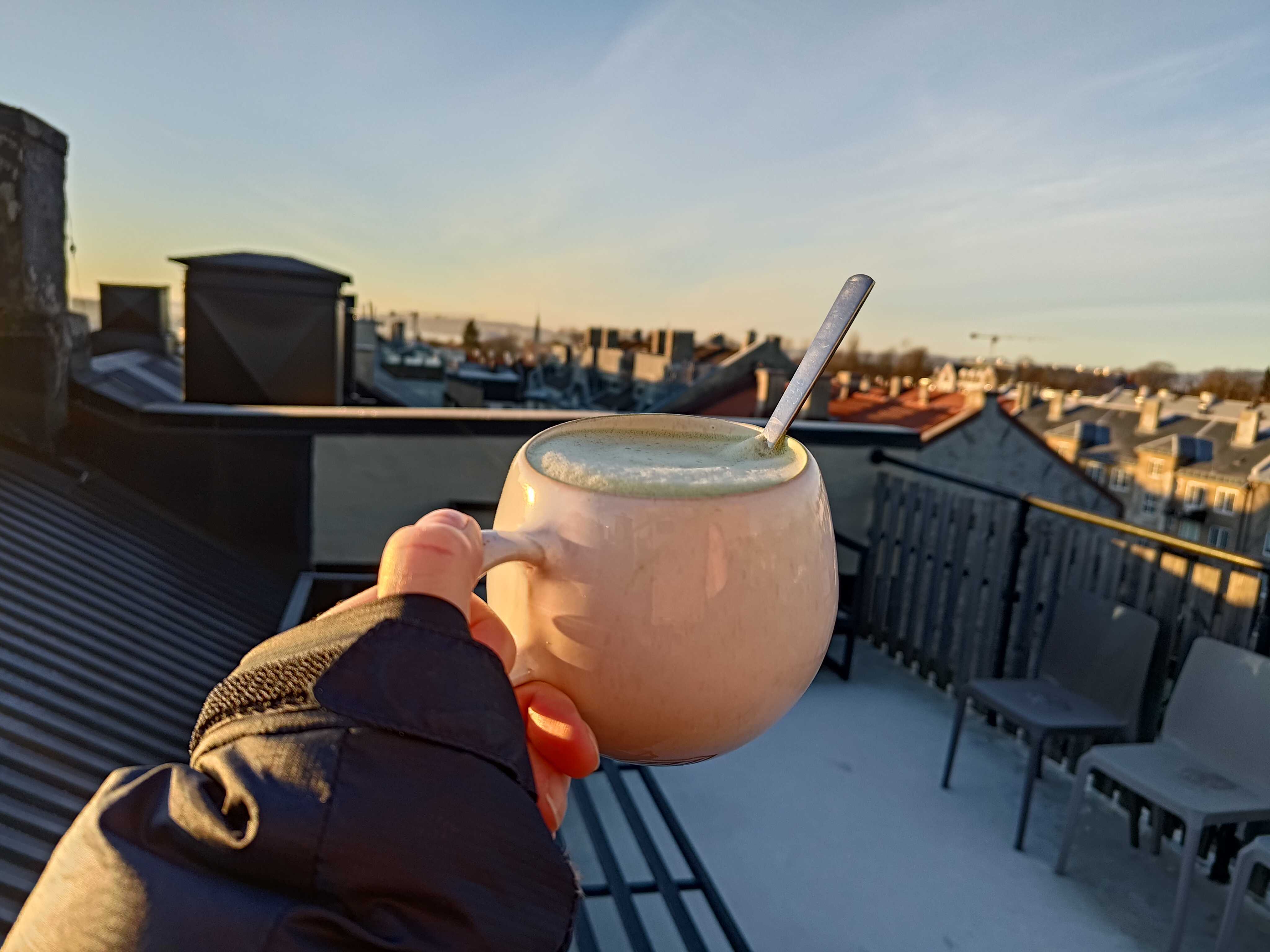
My daily morning mindfulness and meditation practice, before I do anything else, consists of making and drinking matcha tea mindfully. Then doing a guided meditation for 10-60 minutes. It required effort when I started six months ago, but now it’s a habit I truly enjoy.

What do you take away from this? Do you have a clearer sense of what mindfulness meditation is, or are you more confused? Are you motivated to try for yourself? Feel free to comment any thoughts, questions or feedback!

Mindfulness (and) meditation

Getting Older Is

A smiling woman and man wearing traditional conical hats and sunglasses, sitting in a boat on a river.

Worrying about your parents traveling through Southeast Asia, realizing that the tables have turned.

Noticing how your reflection in the mirror keeps changing.

Swapping chronological age for biological age.

Becoming familiar with death and your own mortality.

The greatest gift.

Taking better care of your health.

Forgiving yourself.

Letting go.

Working smarter, not harder.

Paying more attention to one thing at a time.

Shredding insecurities.

Peeling of layers of conditioning.

Taking yourself less seriously.

Befriending your inner child.

Learning how to recognize, set and keep your boundaries.

Becoming more selfish, for the good of the realm.

Waking up to your one wild and precious life.

Becoming yourself.

Falling in love with yourself.

Again. And again. And again.

Getting Older Is