Product Manager Day 2024: Creating an Authentic Conference Experience

On a sunny and rainy Norwegian summer’s day, I woke up excited and early to host our first ever mini conference for 80 Product Managers in NAV. Product Manager Day 2024 was finally happening! Working within budget restrictions and high ambitions to create an authentic conference experience, my colleagues Sigrun, Ingrid og Yvonne and I had spent three previous months designing the program together with the participants, on top of other tasks. Our aim was to boost the strong product managment community within our organization and utilize the competence and engagement that was already present. At the end of the day, the participants rated the experience a total score of 4.74 out of 5 😍. We couldn’t be more proud of the magic we created together with our PM community!

Beside our typical main ingredients for organizing events (structure and planning, facilitation experience, collaboration, and fun 🥳), this post elaborates on five key lessons.
Sigrun and Marianne excited and honoured to welcome 80 amazing PMs to our conference!

Lesson #1: Fewer organizers are more efficient 🚀

After the four organizers had agreed on goals and budget for the event, Sigrun and I had the opportunity to put in some extra effort, and thus took lead of the process. Collaborating in a well functioning pair is super efficient (as I have written about before), and Sigrun and I knew from previous experience we made a great team. A pro-tip when you are co-facilitating or co-organizing is to make sure you and your partner align on ambitions and quality, and support each other.

Now and then we checked in with our sponsor and the other organizers to get feedback and help. When the big day was approaching, we were all in sync and could easily split the rest of the tasks between us to be even more efficient.

For planning tools, we used Trello, Slack, and Mural. In the beginning, the digital whiteboard functioned as a common planning tool, but as Sigrun and I started digging deeper in to details, the board soon became too messy for anyone else to keep track of. We compensated with regularly updating and involving the rest of the organizers on Slack and in weekly meetings.

One of the risks we took was the possibility of one of us getting sick or absent. We barely managed to organize everything on time, and it’s a vulnerability we need to consider for our next big event.

Lesson #2: Details can make the difference, but avoid rabbit holes 🐇

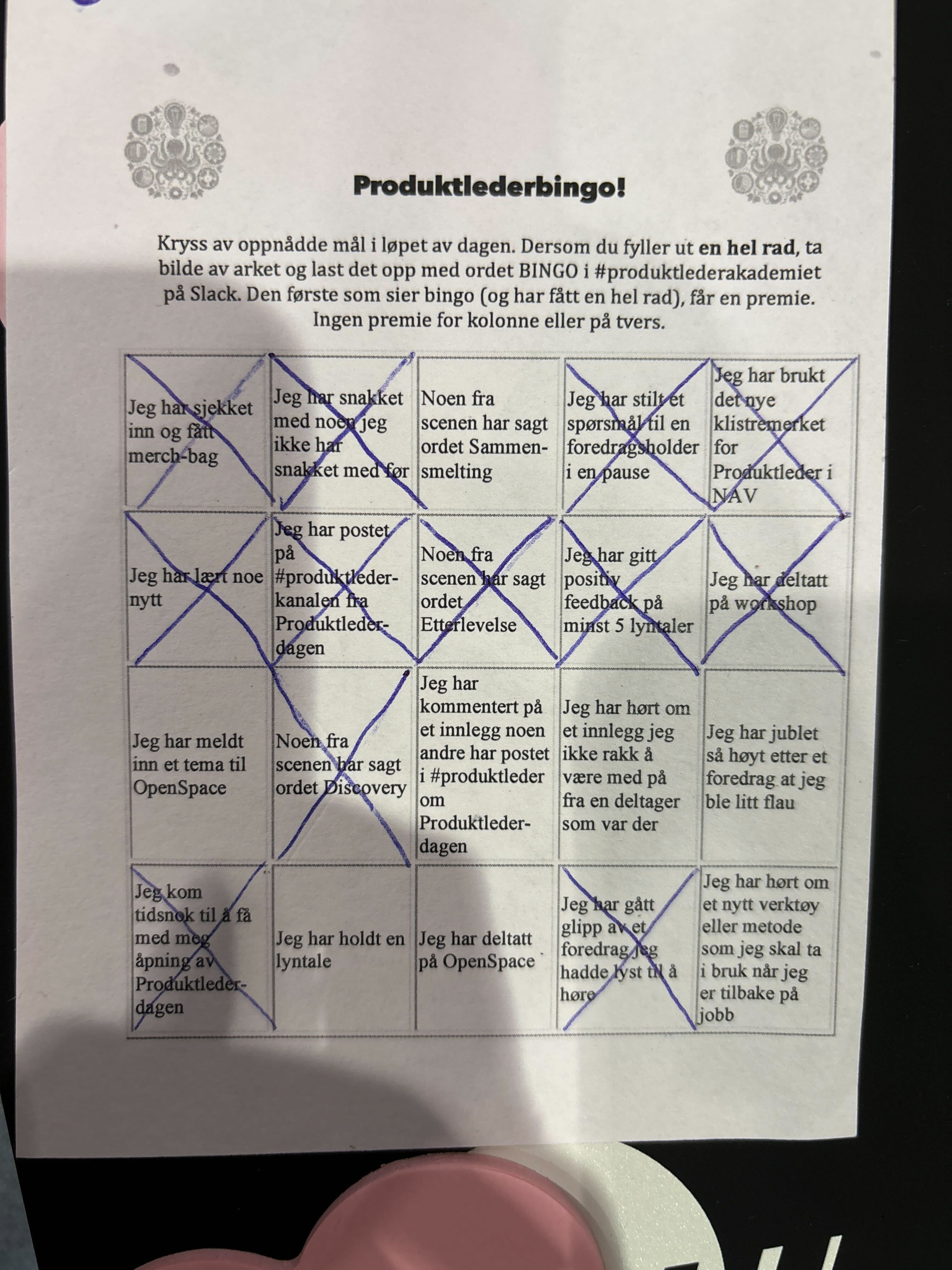
Aiming to create the same feeling you get at an actual conference, Sigrun and I sometimes went a bit over board with the nice-to-have details. We AI generated our own playlist, our own logo 🐙, created stickers, a bingo competition and filled 80 goodie bags with branded merch for each participant. Working late, having too much fun playing with the details, we sometimes had to ask ourselves this question to get our priorities straight:

If we had to organize the event tomorrow, what would we be working on today?

Sigrun and Yvonne providing name tags and merch upon registration.
Bingo competition.

Lesson #3: Create a feeling of abundance and FOMO 🤹‍♀️

The most import ingredient to mimic that authentic conference feeling was for us to pack the program with parallel tracks, to create that frustrating feeling you get when you are forced to miss lots of interesting talks. That way, you have more to discuss during breaks and a stronger incentive to ask questions, network and connect. It also helped shift and rebuild the energy between each session, because it was always a new group attending.
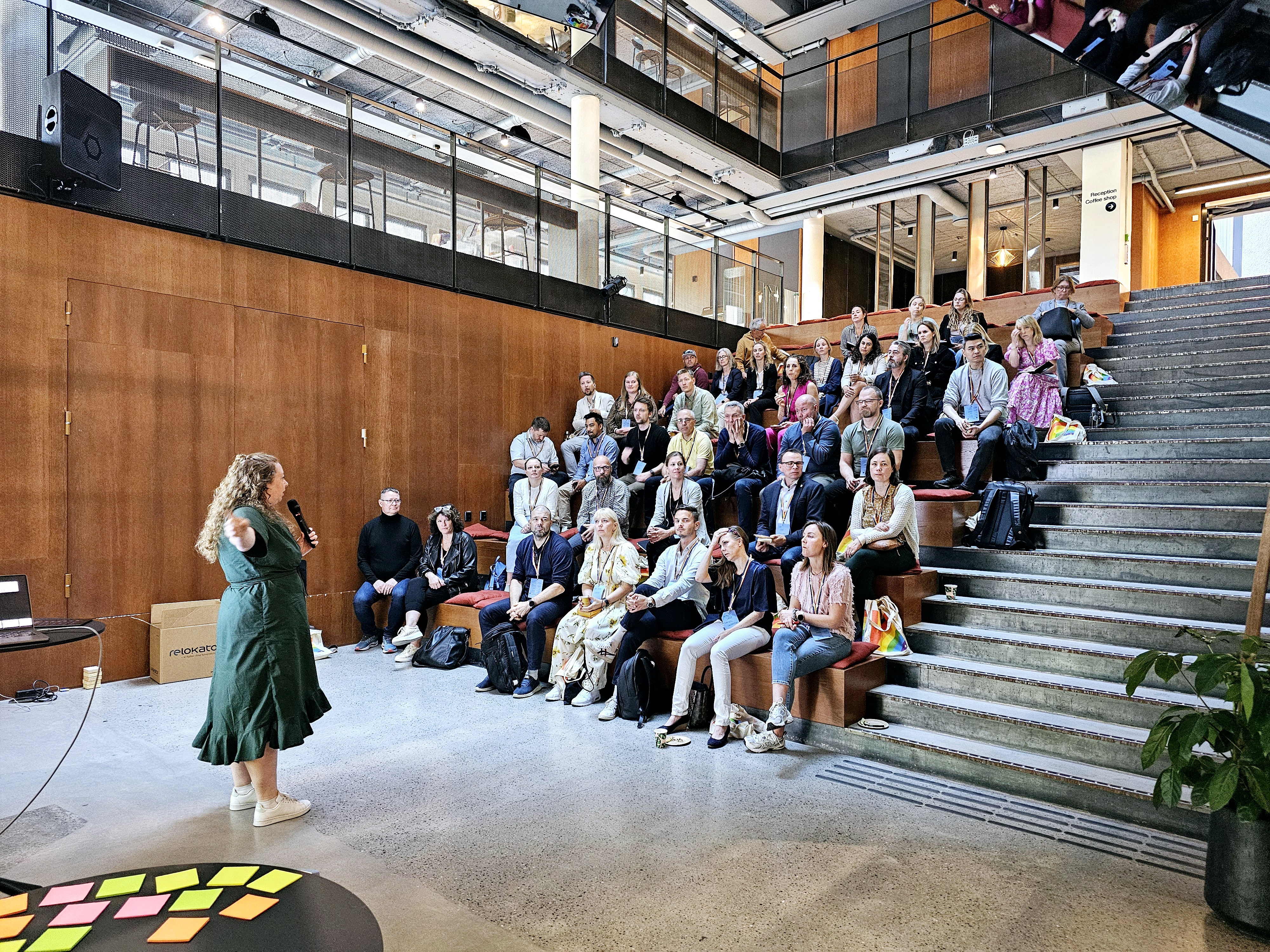
Sigrun leading one of the parallel workshops.
Ingrid leadning the other workshop.

Lesson #4: Invest in your own talent 👨‍🎤

To kickstart the day and bring in some inspiration from outside our company domain, we invited two fantastic keynote speakers from Aidn, Kim and Marius. Having two impressive product people share their honest experience with us lifted the quality of the event. At the same time, we were conscious about our own talent sitting in the audience. When we first sent out the invitation, we invited the participants to contribute, and 16 product managers immediately raised to the challenge. That allowed us to have 16 lightening talks in the parallel tracks.

Our top priority was to be of service to the product managers that were contributing their wisdom, effort, and heart in their lightening talks, to make sure they felt confident when they entered the stage. Sigrun and I offered mentoring, dry run sessions and feedback. At the time of the event, the rest of the audience were instructed to give positive feedback to our lightening speakers, to train our ability to identify each other’s strengths, and to offer a gift of appreciation to our talented pool of speakers. According to positive psychology, focusing on our strengths will allow us to perform better than focusing on our weaknesses.

Positive feedback to one of our awesome lightning speakers.

Lesson #5: Make the rules of the game clear from the start 💎

One of my biggest learning and reminder was to not underestimate the need for explaining rules of new concepts. I have run several Open Space sessions in my organization, also with larger groups, but not with this community. Many had never attended an Open Space before, and I assumed the rules were clearer than they were. Next time, I will share some information beforehand, and explain from the beginning what it means to propose a topic, to make it safe from the start to engage. Once we got going, the participants loved it, and the group discussions were fun and energetic. With the proper framing and introduction, I highly recommend Open Space as a concept!
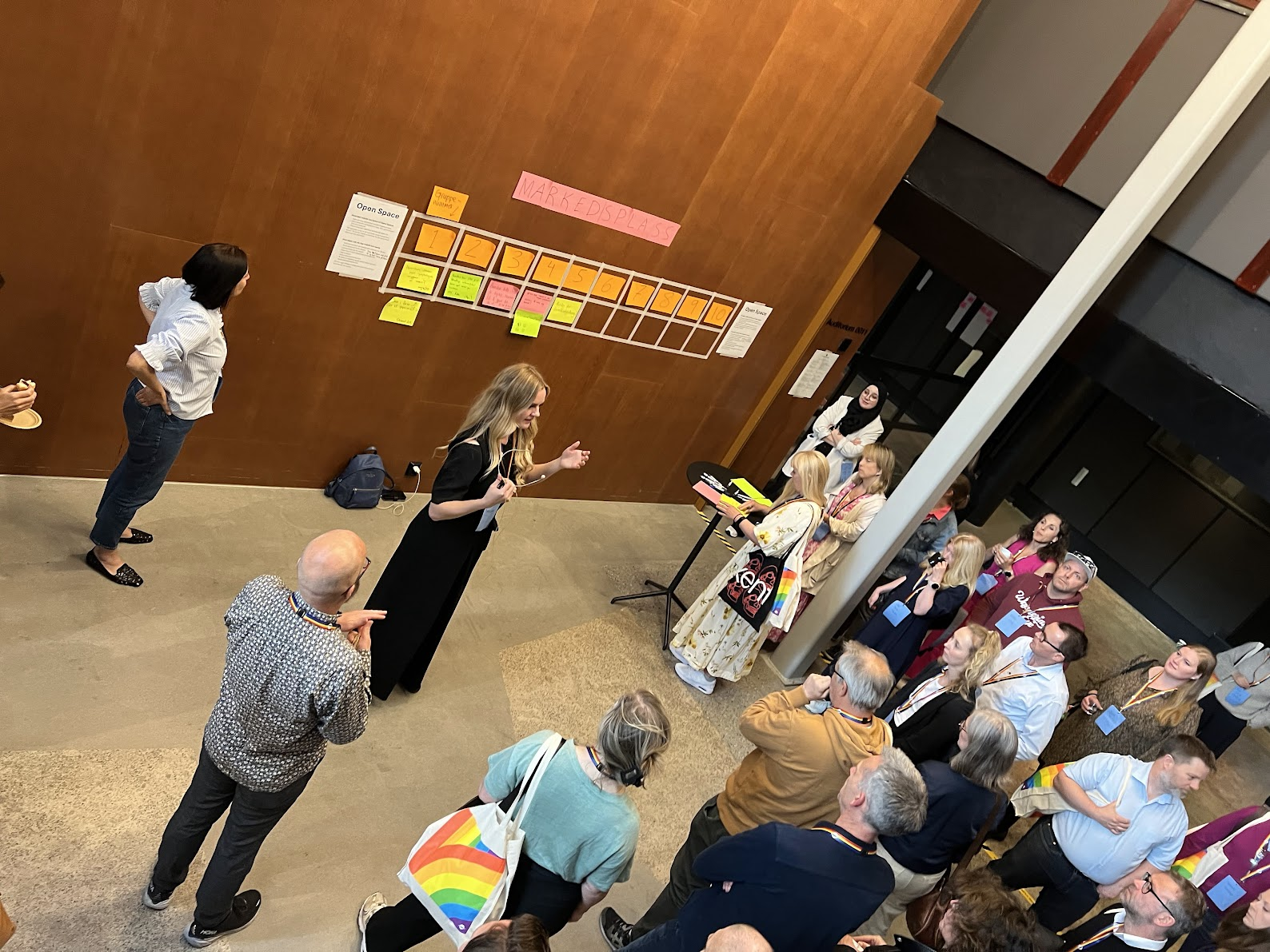
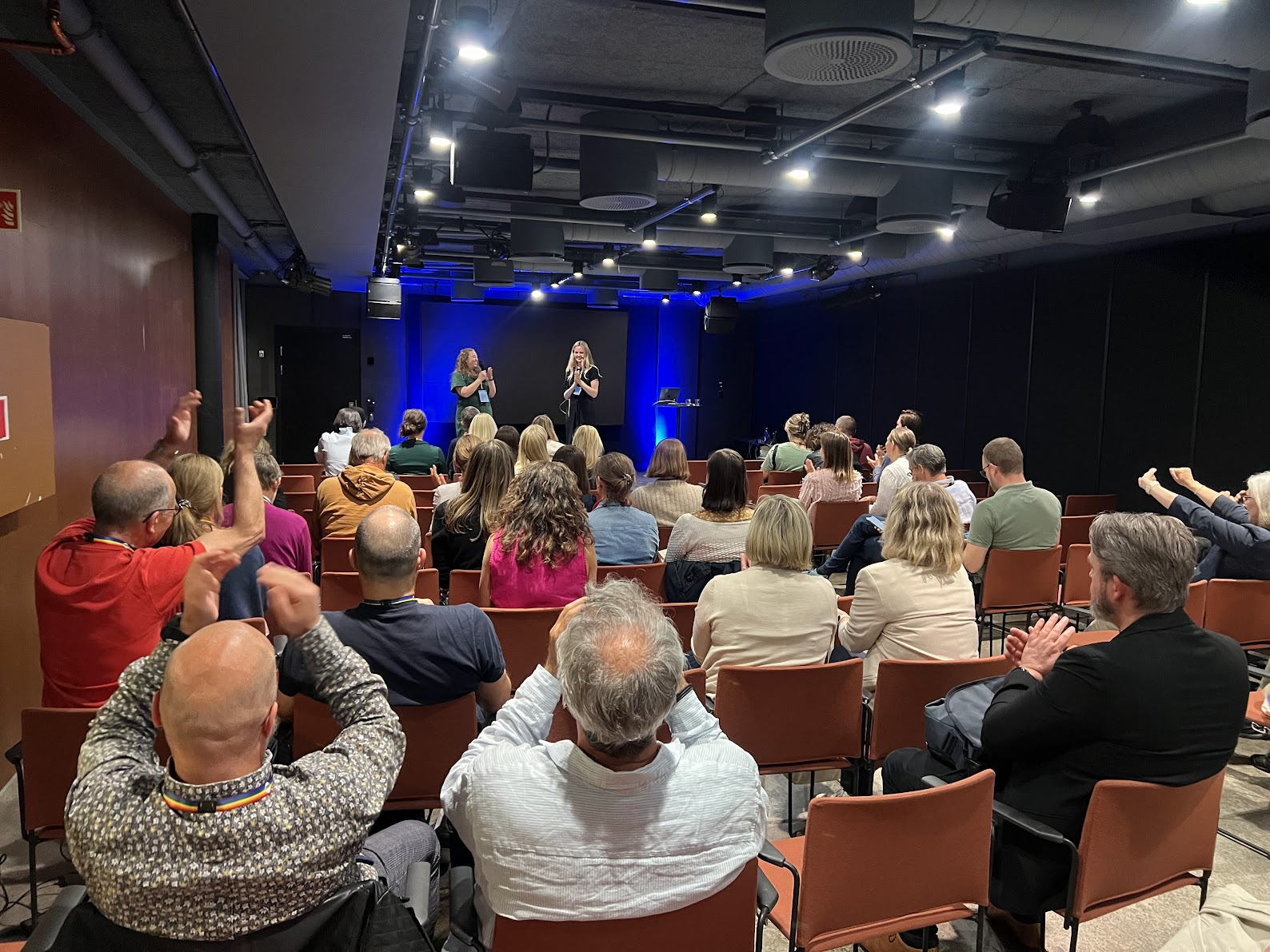
Explaining how Open Space works.
The most engaged and supportive audience ever 👏

Have you organized big events, and what’s your learning experience? What do you take away from our learnings? Where do you disagree? In what other context do you find these and other learnings applicable?


Product Manager Day 2024: Creating an Authentic Conference Experience

Key Considerations When Starting a Community of Practice Inside Your Organization

Do you want to change how your organization works? Or do you have a burning passion for a specific technology or field of practice you want to share with your colleagues? Establishing a community of practice is a powerful tool to help you connect across silos and spread your ideas far beyond your own formal position and without direct authority.

Communities of practice have many valuable benefits, as Emily Weber points out in Building Successful Communites of Practice:

  • Accelerating professional development
  • Breaking down organisational silos
  • Enabling knowledge sharing
  • Building better practice
  • Helping to hire and retain staff
  • Making people happier

Personally, starting a community inside my organizations has been extremly rewarding and motivating. I’m constatly growing and learning together with wonderful colleagues from all over the organization, whom I didn’t know from before. However, starting a brand new initiative yourself is more challenging than joining an existing, well established community.

Based on my own experience, here are some key lessions I hope will motivate you to start a community inside your own organization.

1. Be open and transparent

We had our first meeting in January 2017 and since then we have had regular meetings one hour every other week. The meetings are open for anyone in the organization. We are currently about 100 members, and about 20-30 people turn up at every meeting.

As people hear about our community through word of mouth, they get curious and want to learn more before they join a meeting. So for them to know more about what we do, I make sure to document our values, purpose, members list and every meeting. We use Confluence, and our page is open for everyone to see and even edit. It takes about 30 minutes to write a short summary after every meeting, and maybe post some pictures. This also makes it possible for other people to add stuff and comment on the discussions, even those who didn’t attend the meeting. We also have an open channel at Slack.

2. Change topics, formats and locations

To grow your community requires courage to try new things, and it can be helpful to look at your community as a social experiment. Our default agenda is to split into groups and do lean coffee, but more often than not, we have workshops, lightening talks, discussions, presentations and other formats that members suggests. Make a survey and ask for feedback.

An eye opener for me was that while some people loved heated discussions with lots of interactions in the open canteen, others were uncomfortable and would much rather listen to presentations in a closed meeting room. Because of the variety of personalities and opinions I realized I would not be able to please everyone. Thus I have to constantly change the meetings to include different people. The same goes for topics. For agile, you have to find the right balance between agile for developers (e.g. continuous delivery and DevOps) and the more “soft” people oriented topics of agile (e.g. collaboration and culture). You can of course choose to pinpoint it down a specific area and smaller group, but since agile transformation requires a change in all parts of the organization, I try to broaden up as much as poossible.

3. Diversity matter – Also in opinions

Diversity in gender, neurodiversity and different social and cultural background has proven to be an important factor in creating innovation and value. The same goes for opinions. The best meetups we have is when someone openly feels safe to raise their concerns or disagree with what is being said.

This may sound weird, but it is important for us that you do not have to agree that agile is a good thing to join our agile community. Respect for different opinions is a crucial part of creating an open learning culture and avoiding groupthink and echo chambers.

The best meetups we have is when someone openly feels safe to raise their concerns or disagree with what is being said.

sailors-all-hands-navy-military.jpg
Avoid groupthink and echo chambers.

4. Ask for help

This is one of the many patterns from “Fearless change” that have helped me both run a community and in introducing changes in the projects I’m in.

When I was prevented from hosting a meeting in the last minutes, I asked one of the attendants if he could host the meeting. He said yes, and it went really well. What’s even more amazing is that after that meeting, there suddenly was a summary of what had been discussed up on our Confluence page. Someone had voluntarily, without being asked, stepped up and taken responsibility. I have also had someone else arrange for a social meeting after work, and after asking the community it only took one minute before someone immediately jumped to the task.

By including others and letting them help you out with arrangements, you not just take work off your own shoulders. You expand your network and attract new people to the community. You also make the network less vulnerable by depending on one single leader.

5. Just do it

I often find that we are limited by our mental boundaries of what we think we have permission to do. If you have a great idea you strongly believe in and want to spread across the organization, just make sure the idea aligned with the business goals and you have management support. If your organization values the creativity and passion in their employees, you probably don’t even need all the formal approval you might think you do. One huge advantage of not having a formal mandate is more freedom to explore and try out new experiments as the community grows and takes shape, and less time on reporting and administration.

team-motivation-teamwork-together-53958
Who or what is stopping you  from making something awesome?

The next steps

Being a network of people, a community is somewhat fluid and organic. It is therefore impossible to say where our community will be in a year from now. A community requires constant attention and nurturing, so planning and prioritizing the next steps can still be a good idea.

These are the next actions I am currently looking forward to take in order to grow our community:

  • Creating a safe to fail environment, where people can openly share failures as well as success stories (we have some examples on agile initiatives that have failed, but it can be a higher bar to share those stories if your company is in the early progress of creating a learning culture)
  • Expanding the leadership beyond myself, so that the community is not dependent on only one leader
  • Expanding beyond our own organization, sharing experience and learning with other companies


Key Considerations When Starting a Community of Practice Inside Your Organization